

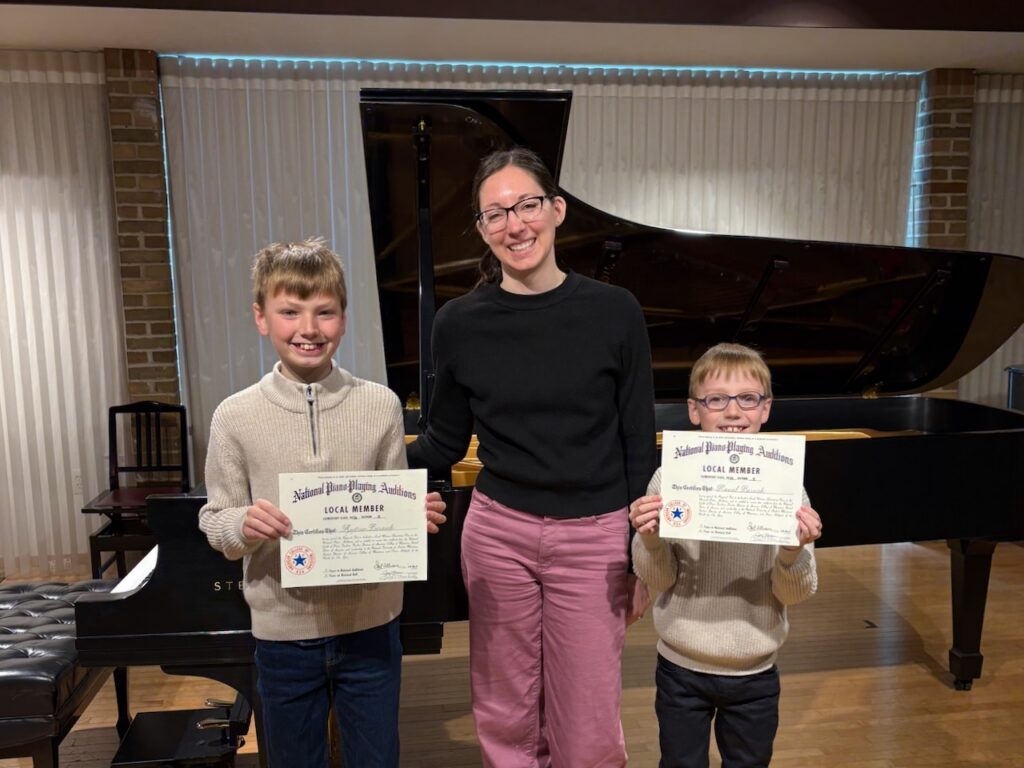
Earlier this month, eight of my students participated in auditions through the National Guild of Piano Teachers for the first time — and so did I, as their teacher. Despite more than twenty years of piano teaching, this was my first experience with Guild. After a few months of learning the syllabus, handling the admin work, and watching my students perform, I came away with a lot to share. I’m glad I took the plunge. In this article, I’ll share what I learned as well as what I see to be the pros and cons of the Guild program.
Backstory
If you know my story at all, you might remember that after grad school my husband and I lived in Northwest Ohio for 8 years before settling in our current town in Southeast Michigan. Back in Ohio, I was fortunate to be active with a couple of small but vibrant local chapters of teachers in the Music Teachers National Association (MTNA). Through those chapters, I had access to a wonderful ribbon festival — a friendly, non-competitive event where students performed for a judge and received written feedback. Having an outside event that encourages all students, no matter how naturally gifted or how seriously or recreationally they approach piano study, is something I value.
After moving to Michigan in December 2019, I hoped to find something in my new locale similar to the ribbon festival. The pandemic put events on hold for a couple of years, and those years overlapped with two of my maternity leaves. It wasn’t until last year that I finally committed to finding a suitable local event.
As you are likely aware, there are a variety of excellent programs piano teachers seeking outside events can choose from. I have also long used the Royal Conservatory of Music (RCM) program (see my RCM technique charts here) for certain students, certain years. I appreciate its top notch piano syllabus, excellent resources (especially the lower levels of the Celebration Series books), highly trained judges, and relatively low admin burden for teachers. In the past, I have served as adjudicator for National Federation of Music Clubs and Michigan’s Student Achievement Testing (SAT), in addition to a couple of local ribbon festivals. Each program has its strengths and advantages.
When a local colleague spread the word that she wanted to re-start a local center of National Piano-Playing Auditions through the National Guild of Piano Teachers — or, as it’s commonly known, “Guild” — I let her know I was interested. I had heard good things about Guild from other teachers and was intrigued hearing them talk of students giving “five-piece programs” or even “ten-piece programs.”
And so, last year, I entered my daughter (then age five) with a five-piece program and this spring, I entered eight students — each with a program of two to five pieces. I’m pleased that the experience overall went well and I plan to enter more students next year.

About Guild
The Piano Guild — formally the National Guild of Piano Teachers, a division of the American College of Musicians — was founded in 1929 by Dr. Irl Allison. The first audition drew just 46 students at Hardin-Simmons University in Abilene, Texas. Today, the Guild operates more than 850 audition centers across the U.S. and abroad, with thousands of students participating each year. Its mission is to establish meaningful, attainable goals for piano students of all levels through noncompetitive auditions — from the earliest beginner to the most advanced player.
There is a learning curve involved any time you acquaint yourself with a new program. With Guild, this was certainly the case for me. There are many guidelines, details, and caveats to learn. The Guild syllabus is lengthy and is unfortunately not laid out in the most user-friendly or visually-inviting way. Thankfully, I have a colleague-friend who has been a lifesaver in answering my questions as I check and double-check my understanding of the program along the way. Her sage advice and tips have made my path easier.
After my first experience with Guild, here is my honest assessment of the program.
Pros:
- I really love the flexibility in this program. Guild very clearly states that it is intended to be an encouraging event for all students. I appreciate that students can be entered at whatever playing level is appropriate to them and can play a program of anywhere from one to twenty pieces!
- Guild suggests students reprogram 2-3 pieces from the previous year’s audition. This encourages students to build a repertoire and makes it more attainable to achieve a five-piece or ten-piece program, for example.
- The Guild syllabus offers a series of optional “Musicianship Phases” — each of which counts as one piece in their program — that students can opt to prepare (if they are performing at least four pieces). For example, students could opt to play phases in scales, chords/cadences, arpeggios, ear training, transposition, improvisation, or sight-reading. The specific requirements for the phases at each level are outlined in the syllabus. Again, I love the flexibility here, and that playing musicianship phases in lieu of pieces counts towards their program.
- Every student beyond the Elementary A level must play the Irreducible Minimum Musicianship Test (IMMT), which means playing certain scales and chord progressions (according to their level) in the keys of their programmed pieces. I really like that these minimum requirements are manageable for any student and that they are practical by being directly related to their repertoire.
- Students can play an original composition as one of their pieces (with reasonable caveats outlined in the syllabus).
- There are many additional goals students can work towards, such as a Composition Competition, Sonata/Sonatina Plaque, Guild Founder’s Plaque, Diplomas, 5-Year National Roll, and much more. Even if most students will not work towards the most challenging goals, I’m glad they are there. When you set a high bar, students often strive higher than they would otherwise!

Neutrals:
- Guild uses many special, official-sounding terms. For example, depending on the number of pieces they decide to play in their program, students are entering as Local, District, State, National, or International fraternity members. The name of the teacher organization is the National Guild of Piano Teachers, while students who participate become members of the National Fraternity of Student Musicians. The local events themselves are called National Piano Playing Auditions. Whew! As I said, very official sounding, which one could argue simply sounds self-important. But on the other hand, it’s exciting for parents and students to feel like they are involved in something that is a big deal. And it is indeed a big deal to prepare for a special event such as this!
- The students’ names are calligraphed by hand on the certificates. Personally, I would be quite alright with having students’ names printed in a beautiful script font on the computer, especially knowing the time and cost involved with the national headquarters having to mail the correct certificates to a calligrapher and then having the certificates mailed to the teacher ahead of the event. But I have to admit the calligraphy work is very beautiful.
- It’s up to the teacher to classify students according to the leveling system: Elementary A, B, C, D, E, or F; Intermediate A, B, C, D, E, or F; and Preparatory A, B, C, or D. The syllabus provides loose benchmarks: students become Intermediate when they can play Clementi Sonatinas; Intermediate to Early Preparatory when they can play Bach Inventions and Mozart Sonatas; and Preparatory/Collegiate when they can play Bach Preludes and Fugues and Beethoven Sonatas. I appreciate this flexibility, though it does require the teacher to learn and apply the system carefully.
- When students play four or more pieces beyond the Elementary level, the teacher is supposed to ensure the program is balanced with music from four style periods: Baroque, Classical, Romantic, and Contemporary. This can be helpful to make sure students are well-rounded, but can also be restrictive for those students who do not have interest in playing a great deal of historical repertoire. There is a separate Jazz/Pop Classification, but there is not a good option for students who want to play across a variety of styles — classical, contemporary, and/or jazz/pop.
- Memorization is required, unless students enter the Hobbyist Classification.
Cons:
- There is a decent amount of admin work involved on the teacher’s part. In addition to preparing your student properly according to the syllabus guidelines, the teacher must collect registration fees and schedule availability from their students, register students online and request a time frame with headquarters, receive certificates and pins in the mail and confirm for accuracy, fill out certain information on the certificates before and after auditions, create a “performing schedule” for the judge to reference, and award the certificates and pins to students after the event. I also attended the event while my students played. That said, I appreciate that event volunteer hours beyond the time frame my own students played were not required.
- I think there is room for Guild to improve their communication methods and better leverage technology. I would like to see more automatic email confirmations for renewing dues, registering students, receiving your Guild time slot, etc.
- Relatedly, I think the syllabus could do a better job providing repertoire examples at each of the levels to help teachers better know where to classify their students. At the end of the syllabus there are some repertoire lists in addition to the general benchmarks they provide, but many of the Elementary-level examples are not widely used teaching materials. Better lists would help make the leveling system clearer for new teachers.
- While the syllabus is complete and informational, overall it’s not the most user-friendly. Guild needs to rewrite their syllabus with the help of a good graphic designer and a good writer. The format needs to be more friendly for any teacher, but especially new teachers.
- I’ve heard that judging can be somewhat inconsistent between judges — meaning, some adjudicate more leniently than others. It would be nice if the judges could be trained to be consistent with each other.
- From what I’ve heard and experienced, in recent years judges are generally not secured until the last minute. This can cause scheduling issues. I hope this will improve.
Every program has its pros and cons, and Guild is no exception. But I came away impressed with how flexible, well-considered, and student-centered the program is. The cons I listed are real — I hope Guild continues to improve in those areas — but they don’t outweigh what makes this program special. I can see why so many teachers have used it for years, and I plan to be one of them.

Getting Started with Guild
Interested in getting started with Guild? Here are a few tips:
- Read the syllabus. Reference it again and again. Make friends with it, and keep it at hand. 🙂
- Definitely find a mentor. It’s really helpful to be able to check with an experienced teacher to ensure you are interpreting the syllabus correctly.
- Consider keeping it simple your first year. For example, this year I decided not to worry about the optional Musicianship Phases available for students playing 4+ pieces. To make the learning process easier on myself, my students all played only the IMMT (as mentioned earlier).
The Results
Our local Ann Arbor center was held at the Faber Piano Institute — yes, the headquarters of Randy and Nancy Faber, authors of the well-known Piano Adventures method. They generously allowed us to use their beautiful venue with excellent pianos — ideal for Guild auditions.

As expected, my students were a little nervous about performing, but they were well-prepared. All eight students performed well and received extremely complimentary report cards from the judge.
I saw proud smiles on the faces of my students and their parents.
One young student said it best after her performance: “I want to do this again next year!”

I couldn’t have said it better myself.
Your turn: What extra-studio events do you enjoy having your students participate in? I’d love to hear!

Although I don’t always have a student participant I too am a member. Congratulations on your students and your accomplishments. That is wonderful and I love colormypiano!
Aw, thank you, Lorri! Thanks for your comment!
Love this article, Joy! Very thorough and I’m glad it was a mostly positive experience for you and your students. I’ve been participating in Guild for 17 years now, and I agree with many of the items you noted about updating forms of communication, syllabus, and leveraging technology. Securing judges wasn’t always an issue – it seems to have become much more difficult in the last 3ish years or so, at least for us in Columbus OH (which is often #1 or 2 for the largest Guild center in the country).
Don’t let the repertoire be too big of an issue for the intermediate levels – while it’s great to strive for with many students, if a student does not cover all the time periods with their program, it’s not the end of the world. It’s one C check they won’t get, and I’ve never had a judge give an A check for it, though I suppose it is possible.
Look forward to hearing more about your experience in future years if you continue Guild!
Hi Rachel! Thanks for your comment! And thanks for the tip about the repertoire for intermediate levels. Your advice is similar to what I received from my mentor-friend, so that is confirming. I still think Guild should consider somehow changing the syllabus if that is something acceptable to do in practice. I do understand and appreciate the guidelines for teachers to strive towards well-rounded historical repertoire, so it’s a change that would require some careful thought. Anyway, I’m happy to hearing from you and other fellow Guild teachers!! Happy summer to you!
Thank you Joy for your informative newsletter. You have taken piano teaching and playing to a grand new level…very impressive! I so appreciate receiving your newsletters. I read them the moment they arrive. The photos of students are great! Take care and our best to you and family!
Thank you so much, dear Patsy! 🙂
Thank you, Joy, for taking the time to outline the Guild program. This will be great to forward to at least one colleague I know who has been wanting to get started with it. I have been happily using Guilds since the 90s. The students and I appreciate having this event as one of the performance goals. Really goes a long way to zero in on the fine details in the repertoire, rather than students glossing over them otherwise. Your Pros/Cons are quite accurate, but as you said, they do not outweigh the value of it for my students! I highly recommend it to any piano teacher!
Miriam, thanks so much for your comment sharing your experience with Guild! I’m happy hearing from you as such a longtime Guild teacher. And I’m glad you feel I captured the pros and cons well. I can certainly see why Guild is to valuable for students and why you’ve been using it since the 90s!
This is so good, Joy!
As an experienced pianist, yet fairly new to teaching piano, I am so so grateful to have come across your blog and worksheets that you have uploaded on your website.
I’m so impressed with how organized you are, how creative, how thorough you are, and how passionate you are!
If you have any comments for new teachers (this is my 2nd year of teaching piano this year) do let me know, as I’d love to hear some good tips and tricks, haha!
Kind regards,
Faustina Weidman
Faustina, thanks for the comment! It’s nice to “meet” you! If I had advice to give an early career teacher, I would advise charging tuition as a flat monthly rate. That is the advice I received early in my career as a young teacher that I am most grateful for today. It allowed me to have good business practices from the beginning that allowed me to focus on the part I love most: the teaching part! Here’s a blog post where I discuss it further: https://colorinmypiano.com/2026/02/05/why-piano-teachers-should-charge-a-flat-monthly-fee-for-lessons-and-how-to-calculate-it/