

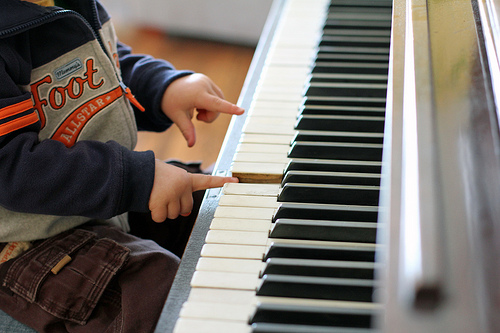
 As piano teachers, we wear many hats. School teachers often teach only one age group, or a few age groups. Piano teachers are usually expected to be able to teach from age 5 to 95! But as we all know, teaching a 5-year-old is much different from teaching a 15-year-old, or a 55-year-old. 🙂
In recently thinking about this challenge of being able to effectively teach various age levels and maturities, I decided to make a list of some of the things I’ve learned over the past few years about teaching young ages — I’m thinking, ages 6 and under. I learned some of these things from an Early Childhood Music course I took during grad school and various piano pedagogy courses — but I learned many of these things purely from experience. Here goes:
- Don’t ask questions that you don’t really want answers to. Examples: “Did you like that?” or “Do you want to try it on your own now?” Sometimes if given the option to opt out of something, children will say “no” simply because you’ve given them a choice. 🙂 It’s better to make statements.
- Give them time to think. When you ask a question, wait for them to process and compose a response. Sometimes we ask questions and then blow right on without getting an answer. Young children need this think time. If you don’t really want to wait for an answer, then don’t ask the question in the first place.
- Only give them tasks and activities that you are 100% sure they will succeed at. Studies have shown that the most effective way to learn is to have a series of successive challenges, where each challenge is only slightly more challenging than the previous. Huge challenges often discourage students — especially when they are young children. Give them small challenges, so they experience many small successes as they learn. My mantra: Always set the student up for success.
- Give concise instructions. If you speak only a few choice words at a time, the student will really listen when you speak. In Dalcroze training, teachers are taught to give no more than a few words of instruction at any given time to children (I think the magic number is 6, if I’m remembering correctly). Sometimes, I find myself babbling when I teach, which can easily lose the child’s attention. I’m trying to teach myself to take a moment to think before I speak. Word choice is important. Challenge yourself to use a limited amount of words before an activity. It will really make you think about what you are saying!
- Be a motivator. A fellow teacher recently said to me: “One of the primary goals of a teacher is to be a motivator.” I think he’s right! Remember that the chief goal is not to get through X amount of pieces or concepts, but to motivate them to want to learn about music. If a child doesn’t “get” a concept on the first try, it’s okay! If you’ve nurtured their excitement about making music, you’ve still met your goal as a teacher that day.
- Model curiosity. Whenever I can, I phrase things as if we are experimenting: “Let’s find out what happens when we…” Student are always excited to find out what what exciting sounds they can make! Actually, this tip works for all ages, but is especially good with young ages in order to capture their attention and nurture a love of learning.
- Get off the bench! Break up sitting activities with activities that allow them to move around a little. Young students need to move! They should not be expected to sit for an entire half-hour lesson. Find or create your own interactive and movement activities that effectively teach the concepts you want them to learn.
- Experience, symbol, then name. Research studies have suggested that this progression is the most effective way to learn. I think this is especially true with young ages. Instead of starting with the terminology for a new concept, start with an activity that allows the student to experience the concept. Then, find an activity that shows then the symbol. Lastly, share the term with the student. This was something that was drilled in my early childhood music college course, but I was also reminded of it in a recent conference session by Marvin Blickenstaff.
- Reinforcement is the way young students will begin to remember things. Don’t assume they will necessarily remember new things after only the first introduction. In my experience, young children will often remember that they learned about the concept, but might not remember the name (which corresponds with the research studies mentioned in the previous post). Don’t make them feel bad for not remembering things the first time. Pleasantly refresh their memory. Strive to present concepts in a variety of ways, from different perspectives, to appeal to different types of learners.
Have any tips to add about working with young students? Leave them in the comments!
Photo Credit: Camera Eye Photography | CC 2.0

Fantastic post. I have a 6-year-old student right now who has kicked my butt on item #1 over the past few weeks. He takes it even a step further: he is a stubborn little guy and so unbelievably perceptive that whenever I ask him a rhetorical question (even ones that are obvious enough for a 3-year-old to answer), he will choose the answer I don’t want. I finally turned to the mom in our most recent lesson and said, “I need to stay away from rhetorical questions with this one.” The mom giggled and nodded. I haven’t noticed this phenomenon as pointedly in the past as I have with this one student. 🙂
Ha! I had a little 5-year-old girl student last year who did the exact same thing! No student has taught me more about being careful with word choice than she did. 🙂
This brings back old memories as I was 5 when I began taking piano lessons. I recall a bad case of stage fright and forgetting everything during a competition…
hehhe… i really like #1 “Don’t ask questions that you don’t really want answers to.” ITS SO TRUE !!!
Joy, My class of 7 new musicians ages 5 -61 just complete their first 8 months of beginners piano lessons. We also did our first recital. I’ve been teaching using your awesome program and outline. Before the holiday break we completed up to review test G. We’ll be starting back up next week. The recital went well and the reception was awesome. If you like to look at how the musicians performed
you can go to http://musicn44soul.webs.com/
I should have I have read more about what to say before I did it..Next time it will be much better. But people where pleased not to many complaint about my speaking voice I’m a work in progress..LOL.
As I said I posted video’s from the recital on my web site. Please leave me your comment there. The musicians would love to get every ones feed back. They are all beginners and this was their first time on stage. . From doing the recital I also signed up two new musicians which will also begin next week.
We look forward to supporting you and your site. Our motto is “Building strong minds with music”. Something I believe strongly in.
Thank you,
Kevin L Wafford
Hi Kevin,
Thanks for your comment, and for sending your website link. What you are doing with your studio is great and very interesting! What a great motto. I know what you mean about speaking at student recitals…in fact, I have a blog post about it which you can check out if you are interested. I think you did a pretty good job though.
Best wishes as you continue your work as a piano teacher and entrepreneur!
Joy
Thank you Joy, coming from you that’s quite a compliment. I’ll keep you and the site posted. I was up late last night preparing lesson plans for the anxious new musicians ready to start lessons next week. Your site is great and extremely a great tool to building strong minds with music.
Thanks for all you do.
Kevin L. Wafford
Thanks alot for your advice. I have gotten to know what areas i need to improve to make my music teaching sessions more lively and effective
Thank you for the great useful tips! Very helpful!
These are amazing tips! Thanks! I’m starting with my first young students next week, this will help a lot.
What a great post! I have a Bachelor’s Degree in Child Development and this was like a review of everything I learned in all of my classes (the more time that goes by from when I graduated, the more often I need reminding of the things I learned… it’s amazing how quickly we forget!). Thanks for posting this.
Thanks for your comment Kelsey — and let us know if you have more wisdom to add to this post!
Hi Joy — Regarding tip #7, do you recommend any movement activities that pertain to piano or music theory? I teach several classes of 3-4 students each, after they have already been in school all day, so they usually have some pent-up energy to get out. What are some good ways to spend that energy while learning about music?
Hi Chris, I would use some Dalcroze-inspired activities. It could be as simple as a “Find the Beat” game where students walk around the room in a circle, walking to the beat. You can play music examples with various tempi. It could be activities where students listen for high versus low or loud versus soft, and must respond to what they hear with a pre-determined movement (arms up, crouching down, or whatever). Another idea is to buy or make your own floor staff. There are tons of hands-on activities that work well on the floor staff. Good luck!
Hello and thanks for the tips. I’m looking for piano method books for introducing the keyboard to kids 3-4 years old. Any that you recommend….?
Anitia,
I’ve been teaching my own children starting at age 3 1/2 and have been using My First Piano Adventure books. My children love them!
My daughter is very imaginative & loves reading, so the Music for Little Mozarts series was perfect for her when she was little (3-5). The stuffed animals were a HUGE hit. She still feels like the famous composers Beethoven, Mozart, etc are her good friends. She especially loved the additional Nutcracker, Christmas & Halloween books. She moved on to other series but still rereads & plays the MFLM books because she really connected with them.
excellent materials on music. Keep it up.
My problem as a new teacher is not knowing what they will succeed at. Any tips for me?
Some of it comes with experience — just trying and learning from working with this age group.
It also helps to choose materials that are developmentally appropriate for young ages. Many of the popular piano methods available today offer a separate set of books intended for young beginners. For example, the Faber method offers the My First Piano Adventures books.
With time, I think you’ll find that you will become very competent at knowing what tasks your young students can handle and succeed at!
Hi thanks for the tips, they are great and I will take them to heart.
I have a 10-year-old student who is very bright, motivated, and learns at a fast pace. Due to her split time between divorced parents, however, she is unable to practice more than once a week. There have been times when I can tell she didn’t practice at all between lessons, to no fault of her own.
Last week’s lesson I knew for a fact she hadn’t practiced in two weeks, and she forgot her lesson book and her note book. We went back to the scales and chord progressions I figured she would remember, which went fine. But then I had her try to sight-read a piece and I’m afraid it only served to frustrate her. We then went to a duet we’ve been practicing for 2 months and she brightened up.
My specific question is, what is a good approach to a lesson when you know your student hasn’t practiced in some time? She’s a great kid and I want to do right by her. Thanks again for the tips, and your time!
Good afternoon Joy,
Thank you for such an informative post!
I have a question regarding pedagogy. I am eighteen years old, and I would like to begin teaching piano students, but I am not sure if this is feasible. I have just completed a Grade Eight Practical Piano Exam, and I have finished all Theoretical Examinations with First Class Honours With Distinction. However, after consulting some websites about pedagogy, I learned that it may not be appropriate for me to teach beginners, as they need very experienced piano teachers. What is your advice regarding this? Would you recommend that I only teach ‘Intermediate’ students? If so, what constitutes as an ‘Intermediate’ student (ie: what skills, knowledge, vocabulary would an ‘Intermediate’ student have?)? How many years of experience/what training would you recommend for me before I can teach beginners? Thank you in advance for you support.
Ledisi, this a very good question. I’d love to converse with you further on this! I’ll send you an email.
The points in this article are also very helpful to remember when working with students with focus or emotional struggles. One of my young gentlemen taught me to be aware of #4. When I start babbling to much he will look at me and say “now you are just talking to me in Spanish!”