

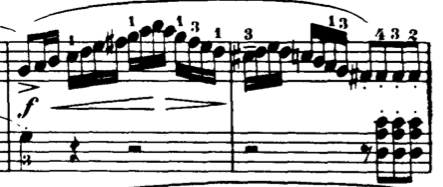
Why do we learn and practice scales? Have you (or your students) ever asked this question? Is it just for tradition’s sake that piano teachers assign scales to work on? I think it’s important not only for we teachers to know the WHY behind scales, but also for our students to know!
My top 5 reasons why we should practice scales:
- Because they appear in music. It makes learning and memorizing scales passages a lot easier if one can identify the scale that the passage is based on. Already in many intermediate-level sonatinas (by Clementi, Kuhlau, and others, for example), there are many instances of scale passages occurring in the piece. If students already know their scales, learning these kinds of passages in their pieces will be much easier.
- To develop coordination between the hands. It’s not easy to get those hands and fingers working together! Practicing scales is a great time to focus on developing coordination which will then transfer over to repertoire pieces.
- To develop a good sense of fingering. It is absolutely crucial to develop a good sense of pianistic fingering at a young age! If students learn good fingering through their scale exercises, then when they encounter similar fingering in their pieces it will seem natural and logical.
- To develop an aural sense of a key / tonal center. Practicing scales will develop the student’s ear so that they begin to hear how each note of the scale functions within a key — e.g., hearing that the leading tone’s pull to the tonic (ti-do). They will also begin to be able to aurally recognize major versus minor pieces they might be learning.
- To build a theoretical understanding of key / tonal center. Knowing about scales and key signatures is the basis of understanding how music works. Once the student understands what it means to be “in a key”, the rest of music theory will eventually follow: they can begin to understand how chords are formed, which chords usually progress to other certain chords, how to transpose, how dissonances are properly resolved to consonances (voice leading), how modulations work, which keys are closely related, etc. And, of course, understanding how music works allows for better interpretations of repertoire. It also makes it easier for students to learn and memorize music if they can understand what is happening.
To summarize, scales are basically where technique and music theory meet. Not only are we developing things like coordination and fingering but we are developing an understanding of keys, which is the foundation of music theory. As an added bonus, learning scales helps with learning and understanding repertoire pieces better.
At first, scales might seem like quite a drag to students. However, if we as teachers celebrate scales by referring to them in their repertoire pieces and their theory worksheets/games, students will begin to understand their importance and appreciate them. Let’s hear it for scales! Hip hip, hooray! =)

5 Reasons to learn scales…oh I do so much agree on this. I have students who are resistive to scales (read-play) and prefer guitar tabs (I refuse to teach them). I ask them “how can a saxophone play guitar tabs?” (well he can’t) .. no; our “language” is the five line staff and the note values, repeats, 1st and 2nd endings, D.S. al Coda, > and < and rests and that is how we talk to each other. Students ask why is a 9th chord called a 9th. Well OK if my bottom finger is "root" or "1" then 1-3-5 is my chord and 8 is my top finger .. the top of the octave. So "9" is outside the octave and 11th is two notes higher and 13th is another two notes higher (well you have to know at least TWO octaves in each major chord to create a 9th, 11th, or 13th .. or an augmented of a diminished). If you want to play inverted chords then you have to know the octave below root. Well all well and dandy but then your buddies say "I won't play more than three sharps or three flats .. it's too hard to remember" (oh gosh .. and the horns need to play two half notes higher). So to play with the horns you will need to understand ALL of the "C" octaves to coordinate with them in the "Bb" octave which cannot be more than "3 up" or "3 down" … and .. to complicate matters more divas like to sing in A and men in D and both mandolins and fiddles prefer A or D. If you want to be in a group (then) you need know scales.
Great post, Joy, I’m absolutely with you! As you so rightly say, scales are perfect to develop tonal center understanding. I’m a choral conductor and pianoteacher and all too often I find that many singers and players have no clue where the music is leading. Like Gitfiddle states, you definitely NEED this to be able to make music with others.
From a pianoteachers point of view though, I am a little cautious in introducing pupils too early in their musical career with practicing scales. In my experience, many students first need to develop enough dexterity in their fingers, wrists and arms before starting with the necessary technique of putting the thumb under or crossing fingers over. I think many methods introduce this (far) too early, resulting in inefficient arm and elbow movement, false accents and other unsollicited results.
I would love to hear your opinion on this! Maybe an idea for a new post?
Best musical regards,
Marie-Astrid Zeinstra
Interesting! I haven’t ever thought that piano methods introduce scales too early (in fact, I’ve felt the opposite way), but I suppose it depends what methods we are talking about!? 🙂 I do think that many books and examination systems introduce hands-together scale playing far too early. But most American piano methods wait quite a long time before they talk about full octave scales. I tend to introduce scales before they appear in the method book, in order to prepare students for when the scales will start appearing in their repertoire. We work with hands-alone scale playing, though, until the student is ready for hands together.
I agree with you about the challenges of scale-playing. Do you have thoughts about what kind of approach or exercises should be used before introducing scales to students? I’d love to hear your thoughts!
I wonder what others think about correct fingering patterns for scales. I have just taken on 2 pupils who are on quite an advanced Grade (Grade 6 and 7 ABRSM). They have both learned their own completely different fingering for scales. It does sound ok when they play and I am wondering if I should be insisting on re learning scale patterns for fingering as I am pretty sure their fingering will not work for more difficult scales? They have both failed their last exams.
Interested to know what others think.
Personally, if the fingerings are logical and the students sound good and play with ease, I would probably allow the students to continue what they are used to! I might, however, also teach them a more traditional set of fingerings just so they are aware of them.
If the fingerings are not logical, the students are not consistent using the fingering, the tone is not good, or the students do not play with ease, I would probably ask the student to learn a more traditional set of fingerings — and I would explain the reasoning to the student in order to motivate them to learn it.